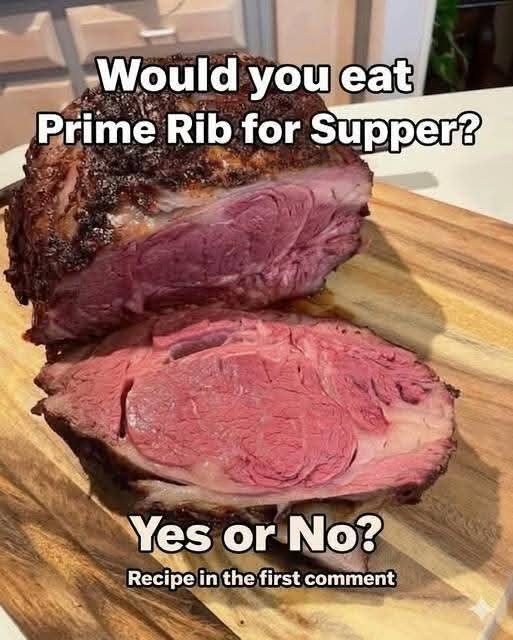
Perfect Garlic Herb Standing Rib Roast Prime Rib The Ultimate Recipe Guide
Few centerpieces command attention at a dinner table quite like a perfectly roasted Standing Rib Roast (Prime Rib). Known for its deep beefy flavor, tender texture, and golden, flavorful herb crust, Prime Rib is the king of holiday feasts and Sunday suppers.
The secret to achieving restaurant-quality prime rib lies in high-heat searing combined with slow roasting to achieve an even medium-rare center from edge to edge with a deeply caramelized outer crust.
Ingredients
The Roast
- 1 Standing Rib Roast (Prime Rib): 3 to 4 bones (approx. 6–8 lbs), bone-in, fat cap trimmed to 1/4 inch.
- Coarse Kosher Salt: 2 tablespoons.
- Freshly Cracked Black Pepper: 1 tablespoon.
Garlic Herb Butter Crust
- Unsalted Butter: 1/2 cup (1 stick), softened to room temperature.
- Garlic: 6 to 8 cloves, finely minced.
- Fresh Rosemary: 2 tablespoons, finely chopped.
- Fresh Thyme: 2 tablespoons, finely chopped.
- Horseradish (optional): 1 tablespoon prepared horseradish for an extra kick.
Classic Au Jus
- Beef Bone Broth: 2 cups.
- Red Wine (Dry): 1/2 cup (e.g., Cabernet Sauvignon or Pinot Noir).
- Pan Drippings: Reserved from roasting.
- Fresh Thyme Sprigs: 2 sprigs.
Step-by-Step Cooking Instructions
Step 1: Salt and Temper the Meat
- Dry Brine (Optional, but recommended): 24 hours before cooking, pat the roast dry with paper towels and season liberally on all sides with coarse kosher salt. Place it uncovered on a wire rack in the refrigerator.
- Bring to Room Temperature: Remove the roast from the fridge 2 hours before cooking. Tempering the meat ensures even cooking throughout the interior.
Step 2: Prepare the Garlic Herb Butter
- Preheat your oven to 450°F (230°C).
- In a small bowl, combine softened butter, minced garlic, chopped rosemary, chopped thyme, black pepper, and prepared horseradish until smooth.
- Slather the garlic herb butter mixture evenly over the entire top and sides of the roast.
Step 3: High-Heat Blast (Searing)
- Place the roast bone-side down in a heavy roasting pan fitted with a rack.
- Roast uncovered at 450°F (230°C) for 15 to 20 minutes to create a rich, brown crust.
Step 4: Low and Slow Roast
- Reduce the oven temperature to 325°F (165°C).
- Insert a digital leave-in meat thermometer into the thickest part of the roast (away from the bone).
- Continue roasting until the internal temperature reaches your target (remember, the temperature will rise 5-7^\circ\text{F} during resting):
- Rare: Pull at 120^\circ\text{F} (Target: 125^\circ\text{F})
- Medium-Rare (Recommended): Pull at 130^\circ\text{F} (Target: 135^\circ\text{F})
- Medium: Pull at 140^\circ\text{F} (Target: 145^\circ\text{F})
- Estimated cooking time: Roughly 13 to 15 minutes per pound at 325°F.
Step 5: Rest the Roast
- Transfer the roast to a wooden cutting board, cover loosely with aluminum foil, and let it rest for 30 minutes.
- Do not skip resting! This allows the muscle fibers to relax and reabsorb juices so every slice remains tender.
Step 6: Make the Au Jus
- Pour off excess fat from the roasting pan, leaving the dark browned bits at the bottom.
- Place the roasting pan on the stovetop over medium heat, add the red wine, and scrape up the browned bits with a wooden spoon.
- Add the beef broth and thyme sprigs; simmer for 5 to 7 minutes until slightly reduced. Strain before serving.
Pro Tips for Success
- Invest in a Meat Thermometer: Time per pound is only a rough guideline; temperature is the only way to guarantee precision.
- Bone-In vs. Boneless: Bone-in roasts act as a natural insulator, keeping the meat juicier during roasting.
- Carving: Cut along the bones to detach the meat roast, then slice horizontally against the grain into thick slabs.