A healthy Thanksgiving cactus can make a small patio table, balcony corner, or indoor windowsill feel instantly brighter and more refined. Even when it is not fully open, the plant already looks decorative because of its segmented green stems and colorful pointed buds. Once the blooms open, it becomes one of those plants that can completely change the mood of a space without taking up much room.
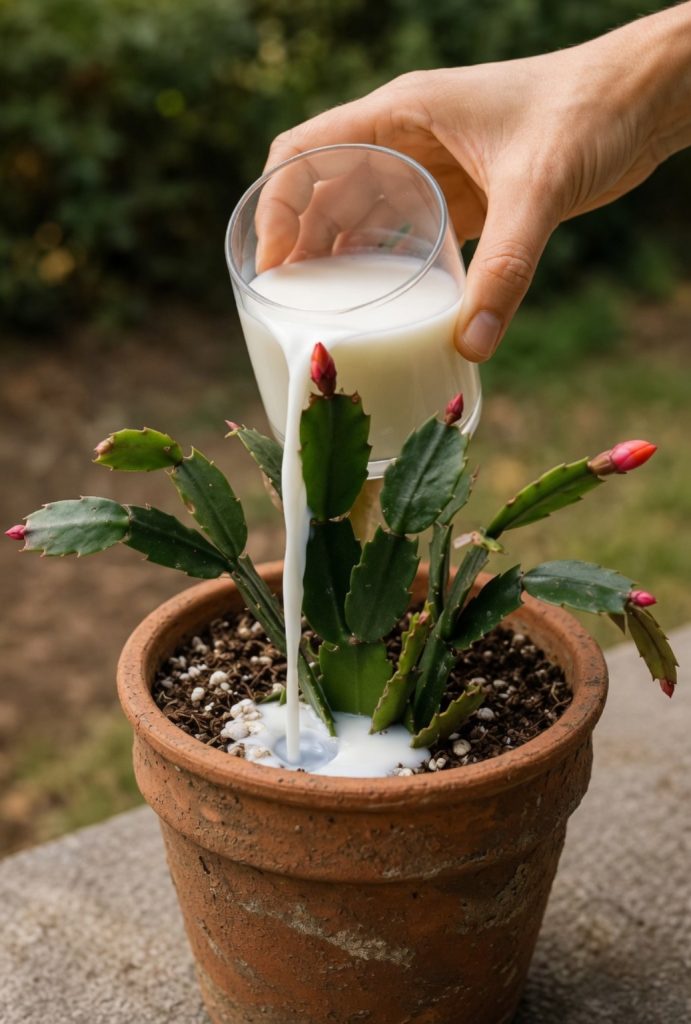
That is exactly why methods like this attract so much attention. In the visual sequence here, the plant appears to be a young Thanksgiving cactus in a terracotta pot with several pink buds already forming. Then a hand pours a light white liquid directly into the soil near the base of the plant. After that, the same cactus is shown looking fuller and more floriferous, with bright pink flowers opening across the plant. The visible message is obvious: the white liquid is being used as a root-zone support step while the plant is moving into a stronger blooming stage.
The most useful explanation is not to pretend that the white liquid is some guaranteed miracle ingredient. From the image and video alone, the exact liquid cannot be confirmed with certainty. It looks like a pale, milk-like homemade tonic or diluted support liquid, but the real identity is not fully clear from the visual by itself. What is clear is how it is being used. It is poured into the soil, not sprayed on the leaves, not rubbed onto the buds, and not used as a decorative surface treatment. That means the grower is clearly targeting the root zone.
That matters because a Thanksgiving cactus does not bloom beautifully because of one ingredient alone. It blooms well when the full care system supports it: bright indirect light, an airy potting mix, controlled watering, a reasonably stable temperature pattern, and a healthy root zone that can support bud development. A light white tonic may be one support step, but the stronger result still comes from the whole setup working together.
What Plant This Appears to Be
This looks like a Thanksgiving cactus, often grouped with holiday cacti.
It can be recognized by:
- flattened segmented stems
- pointed, claw-like edges on the segments
- pink buds forming at the tips
- a compact, upright-to-arching growth habit
- a flowering style that fits Schlumbergera more than a desert cactus
This identification matters because a Thanksgiving cactus is not cared for like a typical desert cactus. It generally prefers brighter indirect light, more even moisture, and gentler support during active growth and budding.
What the Visible Method Is Showing
The sequence is simple once it is explained carefully.
It appears to show:
- A Thanksgiving cactus with several visible pink buds
- A glass holding a pale white liquid
- The liquid being poured directly into the potting mix
- The pour aimed at the base and root zone, not the stems or buds
- A later stage where the plant looks fuller and more heavily blooming
- A final decorative result with bright open flowers and a more balanced shape
So this is clearly a soil and root-zone treatment, not a leaf polish and not a flower spray.
That is important, because the method only makes sense if the grower is trying to support the plant from below.
Why the White Liquid Is Poured Into the Soil
One of the most useful details in the visual is where the liquid goes. It is not spread across the leaves or brushed over the buds. It is directed into the upper soil around the base of the plant.
That suggests the grower wants the liquid to:
- reach the roots
- support the plant from the root zone
- move gradually through the potting mix
- avoid wetting the buds unnecessarily
- act like a tonic or feed rather than a surface treatment
This is exactly how a support liquid would usually be used if the goal is to help the plant strengthen before or during bloom development.
What the White Liquid Might Be
From the visual alone, the exact ingredient cannot be identified with certainty. It appears pale, smooth, and milk-like, so it may be:
- a diluted homemade tonic
- a mild household support liquid
- a light nutrient-style mixture
- another root-zone additive used in small measured amounts
The safest way to explain it is to focus on function, not certainty. The liquid appears to be intended as a gentle support step for the root zone.
That is the key point. The grower seems to be trying to strengthen the plant at the base so it can support fuller buds and better flowering later.
Why This Plant Is Not Treated Like a Desert Cactus
A lot of people make mistakes with holiday cacti because they assume all cacti want the same conditions. This type usually responds better to:
- bright indirect light
- slightly more even moisture
- a lighter, airier medium
- less harsh dry stress
- gentler support while buds are forming
That is why a soft liquid-support method can seem believable in this context. The plant is clearly in an active budding stage, and the grower appears to be trying to support that stage rather than force a sudden change.
Why the Bud Stage Matters So Much
The cactus in the image already has several pointed pink buds. That means it is not being treated as a dead rescue case. It is being supported at a critical moment in its growth cycle.
At the bud stage, the plant is trying to manage:
- energy distribution
- moisture balance
- stem strength
- bud retention
- future flower opening
That is why people often focus more on careful support during this stage. A plant that is already forming buds has something to lose if stress becomes too strong. The grower likely wants the buds to keep developing without dropping or stalling.
Why a Root-Zone Tonic Makes More Sense Than Spraying the Plant
This is another important detail. If the goal were to make the flowers look shinier, the liquid would likely be applied over the plant itself. But that is not what happens. The liquid goes into the pot.
That suggests the real target is:
- root health
- overall plant support
- steadier internal strength
- long-term bloom quality rather than surface appearance
This makes the method more believable than a random leaf treatment.
Why the Later Blooming Result Feels So Strong
The later blooming stage looks impressive because the plant becomes more than a simple potted cactus. It turns into a decorative accent with real presence. That is exactly what people want from a holiday cactus: not just survival, but a plant that actually adds beauty to the space around it.
A fuller blooming Thanksgiving cactus can improve:
- patio tables
- balcony corners
- kitchen windows
- small shelf displays
- entryway tables
- cozy seasonal indoor styling
That is why the final result feels visually valuable.
Why This Is Not a Miracle Shortcut
This is the most important thing to keep clear. The white liquid may be part of the routine, but it is not the whole story. The real result still depends on:
- root health
- the quality of the medium
- light conditions
- watering balance
- the plant’s overall strength
- time
That means the strongest explanation is also the cleanest one: the tonic may help, but the full blooming effect comes from a good care system supporting the plant over time.
How to Use a Similar Method More Safely
If someone wants to try a similar support approach, the safest interpretation of the visual method would be:
Step 1: Start with a healthy budded plant
The cactus should still have firm green segments and visible active buds.
Step 2: Keep it in bright indirect light
The budding stage needs steady energy, but not harsh scorching sun.
Step 3: Use only a light amount of the white liquid
The visual suggests a controlled pour, not a flood.
Step 4: Pour it into the soil near the base
Keep the treatment focused on the root zone, not directly on the buds or stems.
Step 5: Let the plant respond gradually
A stronger bloom display builds over time, not instantly.
Step 6: Keep the rest of the care stable
The tonic should be treated as one step inside a larger care routine, not as the entire solution.
That is the most realistic way to understand what is being shown.
Common Mistakes That Can Ruin This Type of Setup
Even a good-looking method can go wrong if it is exaggerated. The most common mistakes would likely be:
- using too much liquid
- keeping the soil too wet afterward
- assuming the tonic replaces proper light and watering
- stressing the plant while buds are forming
- using a heavy compacted mix that stays soggy
- expecting immediate flowers from one treatment
The strongest results always come from moderation.
Thanksgiving Cactus White-Tonic Table
| Visible Step | What It Suggests | Why It Matters |
|---|---|---|
| Pink buds already present | The plant is in an active budding stage | Support matters more at this moment |
| White liquid poured from a glass | A mild root-zone tonic is being used | Suggests a gentle support step |
| Liquid directed into the soil | The roots are the target | Helps explain the logic of the method |
| Stems stay mostly dry | The treatment is not a surface spray | Keeps the focus on the root zone |
| Later fuller bloom display | The plant responds over time | Shows the effect is gradual, not instant |
Why This Kind of Plant Method Gets Attention
This kind of method attracts attention because it combines:
- a familiar blooming houseplant
- a very visible white liquid
- a simple rooting-zone action
- a later dramatic flowering result
- the idea of a low-effort household support trick
That makes people curious quickly. But what makes the article useful is not the mystery alone. It is the explanation of where the liquid goes, why the root zone matters, why the plant is already budding, and why the result depends on more than one step.
Frequently Asked Questions
Is this a Thanksgiving cactus?
Yes, it strongly appears to be a Thanksgiving cactus because of the pointed segment edges and the bud shape.
What is the white liquid exactly?
It cannot be identified with certainty from the visual alone. It appears to be a light root-zone tonic or support liquid.
Why is the liquid poured into the soil instead of on the plant?
Because the visible method is clearly targeting the root zone rather than the leaf or bud surface.
Can one white liquid make the plant bloom like this by itself?
No. The fuller blooming result still depends on healthy roots, proper light, balanced watering, and time.
Why does the budding stage matter?
Because this is the stage when the plant is trying to hold and develop flowers, so steady support matters more.
Can too much of a tonic hurt the plant?
Yes. Overdoing any liquid support in a pot can create more stress than benefit.