A snake plant already has one of the strongest shapes in indoor decor. Its upright leaves give a room structure, height, and a clean architectural feel without adding visual mess. But when one leaf or a group of leaves is carefully trained into a spiral shape, the plant stops looking like a normal houseplant and starts looking like a deliberate design piece. That is exactly why spiral snake plants get so much attention. They feel more artistic, more premium, and more styled than the standard upright form.
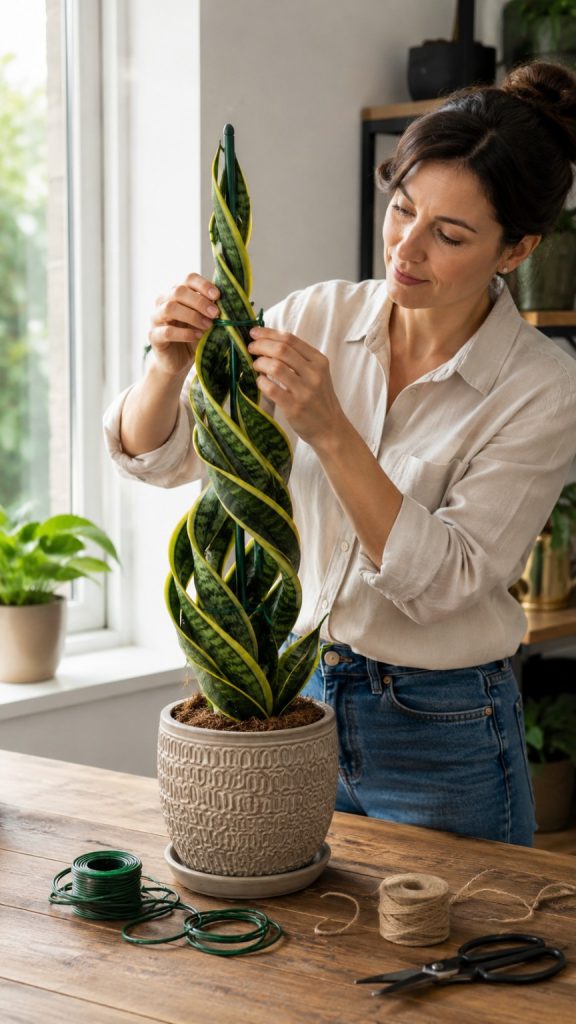
The visual here is very clear. A woman is shaping a variegated snake plant around a vertical support stake. The leaf is being guided in a twisting upward motion, then secured gently with plant ties at key points along the stake. On the table, you can see green garden wire or plant ties, string, and scissors, which tells us this is a hands-on training method, not a feeding trick and not a pruning routine. The whole point is to create a spiral form slowly and cleanly without damaging the leaf.
That detail matters, because a spiral snake plant is not created by forcing the leaf in one quick movement. It is created through training, support, patience, and gentle tension. The plant in the image appears to be a variegated snake plant with yellow-edged leaves, and one long leaf is being wrapped around a central stake to create a corkscrew effect. The ties are not random. They are there to hold the leaf in place while it gradually adapts to the new form.
This is the best way to understand the method. The support stake acts like the spine of the whole design. The ties act like temporary guides. The leaf itself provides the visual drama. When done correctly, the result can look clean, sculptural, and surprisingly luxurious indoors.
What Plant This Appears to Be
This looks like a variegated snake plant, often known as Sansevieria or Dracaena trifasciata.
It can be recognized by:
- upright sword-shaped leaves
- green marbled banding
- yellow leaf margins
- firm architectural structure
- a naturally vertical form that lends itself well to training
Snake plants work especially well for spiral styling because the leaves are stiff enough to hold form, but still flexible enough in the right stage to be guided with care.
What the Visual Is Showing
The image and video appear to show a very specific decorative training method:
- A tall snake plant placed in a textured neutral pot
- A central support stake rising vertically from the middle of the plant
- A long leaf being wrapped around that stake in a spiral pattern
- Plant ties or green support wire securing the leaf at intervals
- Additional tools nearby, including string and scissors
- A final effect that creates a sculptural spiral silhouette
So this is clearly a plant-training method for shape and decor, not a fertilizer method and not a recovery routine.
That is important because the goal here is not simply keeping the plant alive. The goal is shaping it into a stronger visual statement.
What the Support Stake Appears to Do
This is the most important practical part of the whole method.
The support stake acts as the central structure that allows the spiral to happen. Its visible role is to:
- hold the leaf upright
- create a fixed center for wrapping
- keep the spiral shape consistent from bottom to top
- prevent the leaf from twisting unevenly
- make the final design look clean instead of messy
In simple terms, the stake is the frame of the whole spiral. Without it, the leaf would not keep the same smooth upward twist.
What the Green Ties Appear to Do
The green ties or garden wire are just as important as the stake. They are not there for decoration. They are there to keep the leaf in the chosen spiral path while it settles into that position.
Their visible job is to:
- hold the leaf gently against the stake
- secure the twist at important points
- prevent the leaf from springing back
- distribute tension instead of stressing one small point
- help the spiral stay neat and symmetrical
This is why the ties matter so much. The spiral shape depends on gradual support, not raw force.
Why the Leaf Must Be Guided Gently
A snake plant leaf is firm, but it is not indestructible. If someone tries to twist it too fast, several problems can happen:
- the leaf can crease
- the outer surface can split
- the tip can bend sharply
- the leaf can weaken at the base
- the spiral can end up looking uneven or damaged
That is why the visual method makes sense. The leaf is being shaped with both hands, carefully and progressively, while ties are added to stabilize the form.
The strongest spiral designs come from gentle guidance, not aggressive bending.
Which Leaves Work Best for This Method
Not every snake plant leaf is equally suitable for spiral training. A leaf that is already too stiff, too old, or partially damaged is more likely to crack or resist the shape. The best leaf for this kind of method is usually:
- long
- healthy
- firm but not brittle
- free from deep tears or dry edges
- already upright and strong at the base
That is why the plant in the visual looks like a good candidate. The chosen leaf is tall, well-shaped, and visually clean.
Best Time to Start Training a Snake Plant Into a Spiral
Timing matters a lot. The best time to shape a snake plant is usually when the plant is in active growth and the leaf still has enough flexibility to respond well.
This generally makes the most sense when:
- the leaf is mature enough to hold form
- the plant is healthy and actively growing
- the indoor environment is stable
- the plant is not stressed by recent repotting, rot, or severe dryness
- the leaf still has enough flexibility to be guided without cracking
It makes less sense when:
- the plant is badly dehydrated
- the leaf is already deeply scarred
- the plant is weak or yellowing
- the room is extremely cold or dry
- the leaf is so mature and rigid that bending becomes risky
That is because plant training works best when the plant can respond gradually.
How to Do This Method More Safely
If someone wants to copy the visual method, the cleanest and safest approach would be:
Step 1: Choose one healthy tall leaf
Pick a leaf that is upright, clean, and not already damaged.
Step 2: Install a firm vertical support stake
The stake should be stable and strong enough to hold the trained shape.
Step 3: Begin the spiral slowly from the lower section
Do not force the top first. Start where the leaf can be guided more naturally.
Step 4: Wrap the leaf gently around the stake
Guide it in a smooth upward curve, not in hard angles.
Step 5: Use soft plant ties at intervals
Secure the leaf just enough to hold it in place without cutting into it.
Step 6: Check the tension
The ties should support the shape, not squeeze the leaf tightly.
Step 7: Let the plant rest in bright indirect light
A stable environment helps the trained form settle more naturally over time.
This is the most realistic and practical way to create the same effect.
Common Mistakes to Avoid
This kind of method can look simple, but there are several easy ways to ruin the result.
The biggest mistakes are usually:
- twisting the leaf too fast
- using ties that are too tight
- choosing a leaf that is already weak or old
- forcing sharp bends instead of soft curves
- shaping the leaf without a proper central stake
- trying to spiral multiple leaves at once before understanding the method
- ignoring early signs of stress, cracking, or creasing
A spiral snake plant should look elegant. If the leaf is damaged during shaping, the whole premium effect disappears.
How Long the Shape Usually Takes to Look Right
This is not a one-minute result, even if the visual makes it look fast. A beautiful spiral look usually becomes more convincing after the leaf has had time to hold the guided position.
That means the grower should think in terms of:
- gradual shaping
- repeated small adjustments
- clean tie placement
- patience
- steady monitoring
The best result usually comes when the leaf is allowed to settle instead of being forced into a final shape immediately.
Why This Method Feels More Premium Than a Normal Snake Plant
A standard snake plant already looks clean and modern. A spiral one feels more premium because it adds:
- movement
- sculptural form
- a custom styled look
- stronger visual drama
- more deliberate design value
That is why people train snake plants like this. It turns a familiar indoor plant into something that feels curated and artistic.
Spiral Snake Plant Training Table
| Visible Step | What It Suggests | Why It Matters |
|---|---|---|
| Central vertical stake | The leaf needs a stable structure | Keeps the spiral smooth and upright |
| Long leaf wrapped around the stake | The plant is being trained, not cut | Shows the shape is guided gradually |
| Green ties securing the leaf | The spiral is being held in place | Prevents the leaf from springing back |
| String and scissors on the table | This is a hands-on styling method | Reinforces that shaping requires tools and care |
| Clean final spiral silhouette | The goal is decor as much as plant care | Makes the plant feel more sculptural and premium |
Frequently Asked Questions
Is this really a snake plant?
Yes, it strongly appears to be a variegated snake plant.
What is the main purpose of the stake?
The stake acts as the central support that gives the leaf a stable spiral framework.
What do the green ties do?
They hold the leaf in the spiral path while it gradually adapts to the shape.
Can any snake plant leaf be shaped like this?
Not always. The best results usually come from healthy, long, strong leaves that are still flexible enough to be guided.
When is the best time to do this?
It makes the most sense when the plant is healthy, stable, and actively growing.
What mistakes should be avoided?
Twisting too fast, tying too tightly, using a damaged leaf, or forcing hard bends.