Ultimate Guide to Homemade Aloe Vera Hair Oil Complete Recipe for Deep Growth and Repair
Achieving thick, lustrous, and strong hair has been a universal beauty goal across generations, leading many to seek solace in natural botanical remedies. Among the most revered plants in ancient and modern hair care traditions is Aloe vera (Aloe barbadensis miller). While store-bought hair serums and oils often contain synthetic silicones, mineral oils, and heavy chemical preservatives that merely coat the hair shaft, making a custom, nutrient-dense infused Aloe vera oil at home allows you to deliver pure, unadulterated nourishment straight to your scalp and strands. By combining the intensely hydrating, enzyme-rich flesh of fresh Aloe vera leaves with a deeply emollient carrier oil base, you create a powerful hair elixir that stimulates sluggish hair follicles, combats stubborn dandruff, and repairs structural damage from heat styling and environmental exposure. This comprehensive guide explores the deep biochemical science of Aloe vera for hair, provides a detailed step-by-step recipe for crafting your own infused green beauty oil, and outlines professional methods for integrating it into your weekly hair care routine.
The Botanical Science of Aloe Vera for Hair Health
To understand why Aloe vera is uniquely effective at transforming dull, brittle hair into a thick, resilient braid, it helps to examine the active biochemical compounds tucked inside its succulent, gel-filled leaves.
Proteolytic Enzymes for Scalp Cleansing and Renewal
A healthy hair journey always begins at the roots. One of the standout features of Aloe vera gel is its rich content of proteolytic enzymes. These specialized enzymes naturally break down and dissolve dead skin cells that accumulate on the surface of the scalp, which can clog hair follicles and stunt healthy hair growth. By gently exfoliating the scalp matrix, Aloe vera eliminates follicle blockages, reduces flaking caused by dryness or seborrheic dermatitis, and creates an optimal microenvironment for new hair strands to sprout cleanly and dynamically.
Unmatched Hydration and Nutritional Density
Aloe vera gel is composed of roughly 99% water, but the remaining 1% is a highly concentrated powerhouse of over 75 bioactive compounds. It delivers a rich complex of vitamins A, C, and E, which function as potent antioxidants that protect hair follicles from oxidative stress and free radical damage. It also contains vitamin B12 and folic acid, both of which are critical for supporting active cellular division within the hair bulb. Furthermore, the natural polysaccharides and amino acids found in the succulent flesh act as powerful humectants, binding vital moisture to the interior core of the hair shaft to improve overall elasticity and prevent brittle breakage.
Balancing Scalp pH and Enhancing Circulation
The natural pH level of human scalp skin and hair sebum sits between 4.5 and 5.5, a slightly acidic range that keeps the protective cuticle layer flat, smooth, and tightly sealed. Many commercial shampoos and treatments are overly alkaline, which disrupts this balance, roughs up the hair cuticles, and leads to chronic frizz, tangles, and dehydration. Aloe vera possesses a naturally matching, slightly acidic pH that instantly helps restore equilibrium to an irritated scalp. Additionally, its natural minerals, including zinc, copper, and iron, help boost localized microcirculation, ensuring that oxygen and vital nutrients are efficiently delivered to the hair roots to support long-term retention and growth.
Choosing the Ultimate Carrier Oil Matrix
The success of your homemade botanical hair treatment relies heavily on choosing a high-quality carrier oil base that complements your specific hair porosity and scalp type, ensuring that the active nutrients of the Aloe vera are delivered deep into the tissue.
Coconut Oil for Deep Structural Penetration
For those with coarse, curly, high-porosity, or severely damaged hair, pure unrefined coconut oil serves as an exceptional base. Coconut oil is unique because it contains high concentrations of lauric acid, a medium-chain fatty acid with a low molecular weight and a straight linear structure. This specific chemical arrangement allows the oil to physically bypass the outer cuticles and penetrate deep into the internal cortex of the hair shaft, reducing protein loss during washing and significantly reinforcing the structural strength of each individual strand from the inside out.
Extra Virgin Olive Oil for Thick or Dry Hair
If your hair is naturally thick, coarse, or suffers from intense environmental dryness, extra virgin olive oil is an incredibly emollient and comforting choice. Packed with rich oleic acid, palmitic acid, and squalene, olive oil coats the exterior of the hair strands, acting as a natural lubricant that seals in moisture, tames stubborn frizz, and protects the hair from friction damage caused by brushing and styling, leaving a beautifully soft, high-gloss finish.
Jojoba or Sweet Almond Oil for Fine Hair and Sensitive Scalps
For individuals with fine, low-porosity hair or an oily scalp that is easily weighed down, lighter options like jojoba oil or sweet almond oil are ideal. Jojoba oil is technically a liquid wax ester that closely mimics human sebum, allowing it to balance the scalp’s natural oil production effortlessly without clogging pores or leaving a heavy, greasy film. Sweet almond oil is exceptionally rich in vitamin E and magnesium, which work beautifully alongside Aloe vera to soothe scalp inflammation, ease itching, and support lightweight, touchable softness.
Step-by-Step Recipe for Infused Aloe Vera Hair Oil
Crafting this gorgeous green beauty oil at home requires an easy, controlled stovetop extraction process. Utilizing a gentle, low-heat method ensures that you evaporate the natural water content of the plant—which prevents mold growth—while fully infusing the rich fats with Aloe’s active nutrients.
Ingredients and Equipment Checklist
- 1 large, fresh, firm Aloe vera leaf (preferably organic)
- 1 cup of your preferred premium carrier oil (coconut, olive, or jojoba oil)
- A sharp knife and clean cutting board
- A heavy-bottomed stainless steel saucepan
- A fine-mesh kitchen strainer or clean cheesecloth
- A funnel
- A clean, sterilized 8-ounce dark glass bottle with a tight lid or dropper cap
Step 1: Harvesting and Purging the Aloe Gel
Begin by thoroughly washing your fresh Aloe vera leaf under cool running water to remove any dirt or debris, then pat it completely dry with a clean kitchen towel. Stand the leaf upright in a cup or bowl at a slight angle for 10 to 15 minutes. This step is critical because it allows the yellowish sap, known as aloin, to drain out completely from the cut base. Aloin is a bitter latex compound that can cause skin irritation or contact dermatitis on sensitive scalps if not removed. Once drained, wipe away the yellow sap and trim a thin slice off the base of the leaf.
Step 2: Dicing the Leaf for Infusion
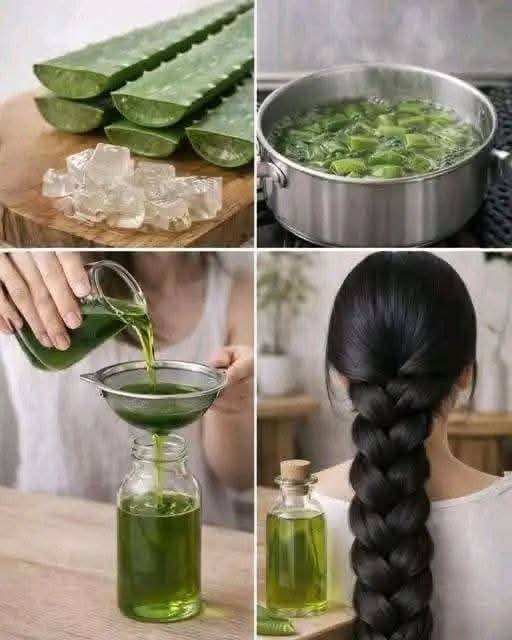
Lay the leaf flat on your cutting board. Using a sharp knife, carefully slice off the sharp, thorny ridges along both edges of the leaf. Cut the remaining leaf crosswise into small, uniform squares or cubes roughly half an inch thick, keeping the green outer skin completely intact. The outer skin contains excellent structural compounds and essential chlorophyll that infuses the oil with a beautiful, natural green hue as seen in the instructional images.
Step 3: Gentle Stovetop Extraction
Place your diced Aloe vera pieces directly into your heavy-bottomed stainless steel saucepan and pour your 1 cup of chosen carrier oil completely over them, ensuring all the plant pieces are thoroughly submerged. Place the pan onto your stovetop over the absolute lowest heat setting possible. As the mixture begins to warm gently, the water content inside the fresh Aloe will begin to simmer and evaporate, creating small bubbles. Keep the heat very low and stir the mixture occasionally with a wooden spoon for 30 to 45 minutes. You will know the process is complete when the bubbling entirely stops, and the Aloe vera pieces transform from vibrant green into a translucent, slightly yellowish-brown color, indicating that all moisture has evaporated and the vital nutrients have been fully absorbed by the oil.
Step 4: Straining and Storing Your Green Elixir
Remove the saucepan from the stove and let the oil cool completely to room temperature. Place a fine-mesh kitchen strainer lined with a layer of clean cheesecloth over a glass measuring cup or bowl. Pour the cooled oil through the cloth, allowing it to drain completely. Gather the corners of the cheesecloth and give it a firm, gentle squeeze to extract every last drop of the nutrient-dense oil from the spent Aloe pieces. Using a funnel, transfer the beautifully tinted green hair oil into a clean, sterilized dark glass bottle. The dark glass is essential as it protects the natural chlorophyll and delicate vitamins from light degradation, keeping your oil fresh and highly potent.
Professional Application Techniques for Maximum Growth
To unlock the full potential of your homemade Aloe vera oil, it should be applied mindfully using targeted methods designed to encourage scalp health and deep strand repair.
The Weekly Hot Oil Scalp Treatment
For a deeply therapeutic treatment that targets hair thinning and dryness, incorporate a weekly hot oil massage. Pour 2 to 3 tablespoons of your Aloe vera oil into a small glass bowl and warm it gently by placing the bowl in a container of hot water for a few minutes. Section your dry hair and apply the warm oil directly onto your scalp using a cotton ball or your fingertips. Once the entire scalp is coated, perform a firm, circular inversion massage for 5 to 10 minutes to stimulate blood flow. Work the remaining oil down through the lengths of your hair to the very tips. Cover your head with a shower cap or warm towel and let the oil sit for at least 45 to 60 minutes—or overnight for deep conditioning—before washing thoroughly with a mild, sulfate-free shampoo.
Lightweight Split-End and Frizz Serum
This versatile oil can also be utilized as a daily lightweight leave-in serum to protect your hair from styling friction and environmental dehydration. After washing and towel-drying your hair, rub a mere 2 to 3 drops of the Aloe vera hair oil completely between the palms of your hands. Smooth your hands gently through the mid-lengths and ends of your damp hair, focusing particularly on split-end-prone tips. This creates an invisible, micro-thin lipid barrier that locks in hydration, smooths down the cuticle layer, tames flyaways, and adds a brilliant, natural shine without weighing down your style.
Essential Safety Guidelines and Storage Practices
Because homemade botanical cosmetics do not contain synthetic chemical stabilizers, utilizing proper handling and storage techniques ensures your product remains clean, effective, and completely safe for routine use.
The Importance of the 24-Hour Patch Test
Even though Aloe vera and natural carrier oils are famously gentle, topical botanical extracts contain highly concentrated plant proteins that can occasionally trigger a localized allergic reaction. Before applying your newly crafted oil to your scalp, always perform a basic patch test. Apply 2 drops of the infused oil to a small patch of skin on your inner forearm or behind your ear and leave it undisturbed for 24 hours. If you notice any redness, itching, burning, bumps, or swelling, discontinue use immediately. If the skin remains perfectly calm and comfortable, you can safely proceed with your hair care treatments.
Extending the Shelf Life of Preservative-Free Oils
When prepared correctly using the low-heat method to completely evaporate the plant’s water content, your homemade Aloe vera hair oil will remain fresh and stable at room temperature for roughly 3 to 6 months. To maximize its longevity, always store the bottle in a cool, dark cupboard away from direct sunlight, high humidity, and heat sources like stoves. Always ensure your hands are clean and completely dry before handling the bottle, as introducing external water droplets into the container can ruin the lipid stability and invite mold. For advanced protection, you can pop open a single capsule of vitamin E oil and stir it into the batch after straining; vitamin E acts as a spectacular natural antioxidant that shields the carrier oils from turning rancid.
Frequently Asked Questions (FAQs)
Can I use store-bought Aloe vera gel instead of a fresh leaf?
It is not recommended to use store-bought tubed Aloe vera gel for this specific oil infusion recipe. Commercial gels are heavily processed water-based products that contain thickeners, gelling agents, water, and synthetic preservatives. Attempting to heat commercial gel in a pan of oil will result in an explosive splattering reaction due to the water content, and the ingredients will not blend or infuse correctly into a cohesive oil matrix. Always use fresh, whole leaves for traditional oil maceration.
How many times a week should I use this hair oil?
For most hair types, utilizing the oil as a deep scalp and hair mask 1 to 2 times a week yields exceptional, visible results without cluttering your styling routine. If you have an exceptionally dry or flaky scalp, you may comfortably use it up to 3 times a week. If you have fine hair that leans toward oily, limit your application to once a week as a pre-shampoo treatment, focusing the oil primarily on the mid-lengths and tips rather than heavily saturating the roots.
Will this oil make my hair grow faster?
While no topical treatment can alter your body’s baseline genetic growth speed, this Aloe vera oil actively creates the ultimate environmental conditions for maximum healthy growth. By clearing away dead skin cells, soothing follicle inflammation, delivering critical vitamins directly to the roots, and drastically reducing strand breakage and split ends, your hair is able to retain its length efficiently, resulting in a significantly thicker, longer, and fuller appearance over time.
How do I easily wash the oil out of my hair?
If you applied a generous amount of oil for a deep mask, removing it effortlessly without stripping your hair requires a simple trick. Before turning on the shower water, apply a small amount of your regular shampoo directly onto your dry, oil-saturated hair and work it through gently. The surfactants in the shampoo will bond immediately to the oils. Once you rinse with warm water and follow up with a light second wash, the oil will lift away completely cleanly, leaving your hair beautifully soft, light, and perfectly clean.
Conclusion
Crafting your own batch of infused Aloe vera hair oil is a deeply rewarding, beautiful journey into traditional, plant-based self-care. By bypassing complex chemical formulations and embracing the natural synergy of proteolytic enzymes, vital polysaccharides, and moisture-locking carrier oils, you can easily provide your scalp and strands with professional, salon-quality nourishment from the comfort of your kitchen. Whether used as a rich, warm weekly scalp treatment to encourage dynamic thickness, or as a daily smoothing glaze to protect your ends from breakage, this stunning green elixir is a true testament to the timeless power of simple, whole-plant cosmetics. Select your premium leaf, simmer your infusion with patience, and enjoy the wonderful, therapeutic process of nurturing your hair back to its absolute peak of radiant, lustrous health.